By Rama Calaga and Nuria Valverde Alonso (CERN)
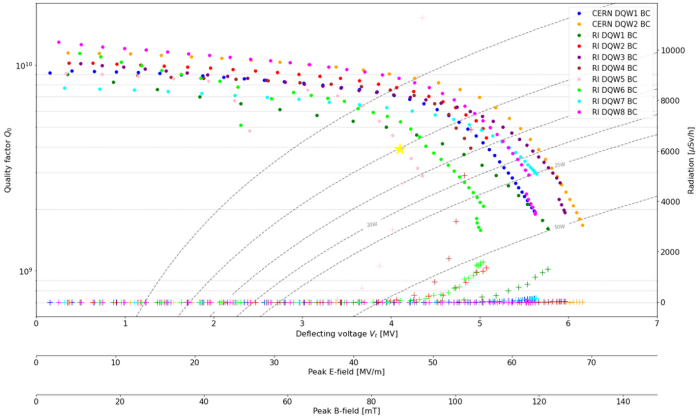
Following etching and most-recent tests of the final 6 bare DQW crab cavities delivered to CERN earlier this year, the whole DQW series has been qualified.
The contract to build 10 series DQW crab cavities cavities, starting with a prototype, was awarded to Research Instruments (RI) in 2018. This was re-scoped in 2022 to 8 series cavities, with the remaining 2 cavities to be manufactured at CERN.
RI delivered the first pair of series cavities in 2022. After successful RF testing at 2 Kelvin, and well beyond the specification, RI completed the final step of the assembly of a Helium tank (aka jacketing) on each of the two cavities in August 2023. The two jacketed cavities also qualified well beyond the specification and were equipped with HOM couplers and a field antenna in their final configuration (aka dressed cavities) before cryostating. Both dressed cavities reached above the specification and, along with the CERN-built cavities, were sent to UK-STFC for their cryostating into the first two series cryomodules for the HL-LHC.
RI delivered the remaining six DQW series cavities at the end of 2024, including the surface treatment and in a cold test configuration. During the tests at 2 Kelvin in SM18 at CERN, all six cavities revealed limitations at low deflecting field due to early onset of field emission. However, based on the experience from past crab cavity tests, a light surface chemistry was deemed a mitigation technique; approximately 30 microns of RF surface was etched on each of the cavities at the CERN TE-VSC facility. All six cavities were then re-tested and shown to easily surpass the specification.
These results successfully qualify all 10 series DQW bare cavities, a major milestone for the crab cavity project for the HL-LHC. The cavities have been sent back to RI for the Helium tank assembly, and the jacketed cavities are expected to come back to CERN in the first half of of 2026 for qualification.
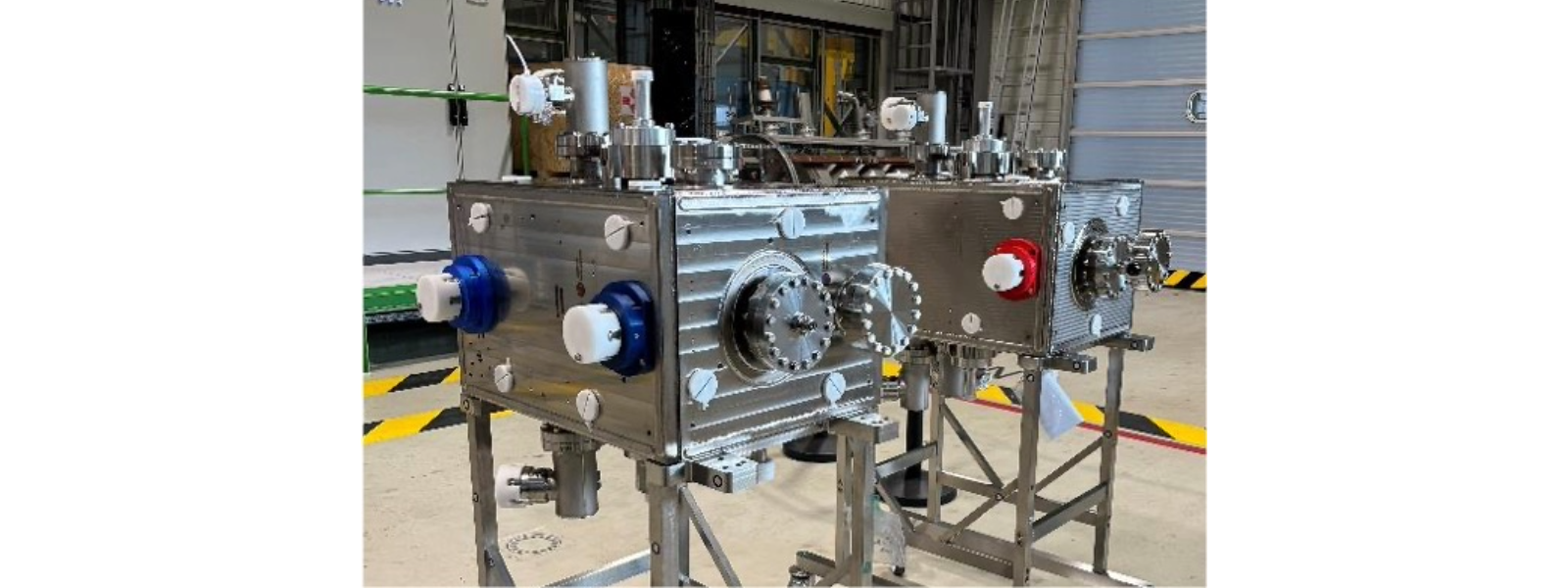
Figure 2. Two series DQW crab cavities.